Showing posts with label About the Philippines. Show all posts

Monday, April 29, 2013

Lit and summer likes.

I remember in high school how I hated Literature. For four years we read Shakespeare's works plus those of Carl Sandburg, Keats, Shelley, Browning, and other American and English writers and poets. We disliked Literature because we couldn't understand them, and perhaps because the teachers were un-interesting.

To a teen, Mark Anthony and Cleopatra, Silas Marner, Portia and Annabel Lee were distant personas and we were busy liking John, Paul, George and Ringo or the fab four (The Beatles) as they were called then.
Portia and Shylock in William Shakespeare's  Merchant of Venice

Other times we were busy planning for afternoon soirees and eagerly waiting for the appearance of our high school crushes during lunch break and dismissal.

High school algebra was boring because of the teacher but English was interesting and so was Spanish.

The Monkees, like the Beatles, also ruled the airwaves and the Ed Sullivan show was the top ranking US variety show.

Locally, the Sampaguita stars who ruled the late sixties and the seventies' big screen were the Batang Bakasyonistas, Batang Artista and Batang Iskwater - the likes of Rosemarie Sonora, Gina Pareno, Blanca Gomez and Loretta Marquez and the guys, Pepito Rodriguez, Bert Leroy Jr., Dindo Fernando and Edgar Salcedo.

RJ Jacinto and the Moonstrucks were Manila's top bands, and house parties were the craze with neighbourhood bands providing the music. Bye Bye, Jerk and Mash Potatoes were the dances much like today's gangnam fame. 

Boogie woogie was passe, clean cut was out, and bell bottoms, printed shirts, clogs and long hair were the fads.
Formal attire of the mid-70s.  Princess Anne and Capt. Mark Philips' engagement announcement in 1973


At school and at parties, boys took to one side and girls at the other side. Boys went to the girl's house some weekend evenings if he were interested in a girl, and brought gifts, too.

Phone pals and song hits were the buzz words, and local TV dance shows had titles like Dance O' Rama and Night Owl.


Manila's streets were relatively safer as gangs or "tambays," hang out at neighbourhood convenience or sari sari stores, and only victimized girls through their hoots or whistles or pranks.

Street drugs were unknown and local liquor were San Miguel Beer, Tanduay Rhum,  Ginebra San Miguel and the liquor cum tonic called Sioktong.

Sioktong came in bottles and can be bought by glass. (Note: you bring your own glass and the grocer or sari sari store owner poured the Siok Tong)
 

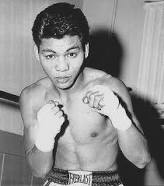
Gabriel "Flash" Elorde was the masses' sports hero and Mang Paeng (Rafael Yabut), and Damian Soto were the radio super newscasters and commentators.
The young Gabriel "Flash" Elorde, world's junior lightweight champion for seven years

Gabi ng Lagim, Lagalag, and Tia Dely were the radio drama and suspense hits, and Botica sa Baryo was Sunday evening's comic relief.

On TV, the Three Stooges and Superman were the the young people's favorites.

Local chocolates had names like Nectar and Nestor, and buns and bread were called pan de buntal, pan de limon, and kababayan.

Mid-morning and mid-afternoon reading materials were Tagalog comic books like Hiwaga Klasiks, Pilipino Komiks, Espesyal and the Liwayway Magazine. They were the Lit of neighbourhood kids.


Monday, February 25, 2013

Memos and Memories.

I don't miss reading nor making memos. If my memory serves me right, I hated memos.

Pre-inter-office emails, memos or inter-office memorandums were typewritten and distributed as hard copies. So, at the start of the day, any self respecting office guy/gal rummaged through his/her inbox and read the memos buried there.

Then there were the tasks to be done, and memos to be written back.

Came the advent of emails, and memos, like virus, spread as quickly as the dengue-carrying mosquito.

There was no stopping, bosses didn't ask their secretaries nor admin assistants to type out the memos, they did themselves.

And then the voice mail was born, and office life became one big message and communication centre. People were opening emails and playing voice mails all day, and into night as one responds to private emails and voice mail messages at home.

Texting came along, too, and even while sleeping, people got woken up by the vibrating cellphone, and were literally forced to read text messages in the dark.

It's the 27th anniversary of EDSA I revolution today. 1986 seems so far flung in the innards of our stomachs and nerve centres of our brain.  In 1986, we still relied on broadsheets, radio and television to carry the news of the day. The internet was still the sole property of the U.S. military.

 In the USA where I was when EDSA fell to the good guys, I was glued to CNN.
PEOPLE POWER, a scene along EDSA, circa 1986

Saturday, November 24, 2012

My Life in a Bus.

When I was commuting to U. P. Diliman (the Philippine state university) many years ago, I'd take the jeepney (U.S.-converted military jeep) from Mandaluyong (a city in Metro Manila) to Quiapo of the famed Black Nazarene and then transfer to a bus which went straight inside the state university.

There were two bus companies that plied the Quiapo - Diliman route: the JD Bus and the MD.

JD was a bit smaller and was colored pink and MD was bigger and was off white.

The JD conductress wore a crisp, (pwedeng tumayo dahil sa almirol) pink uniform, and MD employed male conductors who wore grey shirt and pants.

Those bus trips took about less than hour. Once the bus went under the Quaipo underpass and up onwards to Espana, you'd be in the Welcome Rotonda in less than ten minutes, and then on to Quezon Boulevard, on to the Delta Circle, and right onto the Eliptical Road.

Elliptical Road/Rotonda was a huge expanse of green grass and the the Quezon City Hall was an imposing structure.  The U.P. Teacher's Village was a landmark, and when the bus turned right at the corner of Philcoa to the road leading the University, it was a wide, uncluttered lane.
Elliptical Road of yesteryear.

Then you saw the U.P. Oblation and this freshman's heart was aflutter - tense on the very first semester.

Luckily, U.P. had the block system in force then, so we freshmen  had the same classmates in all our classes, English 11, Math 11, Humanities 11, Spanish 11, etc.  We only had classes leading to our major or specialization on our second/third years.

The buses plying Manila and towns off Manila were not air conditioned; the first air con bus came after Martial Law had been imposed, and it was called the Love Bus.
The Manila Love Bus, first rolled down Manila streets a few years after Martial Law had been declared

So JD and MD had their windows wide open. I remember JD had those lawanit-type, pull down windows. I actually preferred the MD bus because it was bigger and had wider alleys so when there were no more seats available and you had to stand up, it was more comfortable.

Pickpockets were rare then, so passengers were more relaxed.

When our family car was not available and we had to go home to our home province, our family took either the Bautista Liner or the Baliwag Transit. The Bautista Liner ceased operation many years ago, but the Baliwag Transit is still robustly transferring commuters to many points in Central and Northern Luzon today.

Those Baliwag trips, though rare, were memorable.  We usually clustered at the back of the bus, being a large family of ten, and one relative was a conductor, so he'd arrange for our seats in advance

Once, we went to Baguio and took the air conditioned Pantranco Bus at its terminal in Quezon City. I was with my aunt and two sisters and we had the late comedienne Dely Atay Atayan as co-passenger.

And right after Martial Law was declared, we travelled up Philippine north on a Pantranco bus, too, and had soldiers stopping the trip and inspecting the bus and passengers more than once. It was a scary ride.

In Jersey city, bus was my main means of transportation when I worked in Manhattan. I would wait at the corner of West side for the bus going to Journal Square where I transferred to the Path Train for the last stop at the World Trade.

When I moved to Sayreville, New Jersey, I had a daily bus commute from Jersey to 47th street, and then I'd walked up to 57th.

In Toronto, I rarely take the bus, but when I do it is the  Metro wherein you paid one fare and included a transfer, either to the subway or another connecting bus ride.
Toronto Transit Bus bound for Warden in Scarborough

Metro Toronto offers special discounted rates to students and you can purchase  a monthly pass or a weekly pass which give more savings than daily tokens.

On a trip to the west coast recently, we took the Greyhound bus from Las Vegas to L.A., all five hours of it and stopped to eat at a Mexican resto featuring Filipino pancit and adobo. 
Greyhound Bust stop at Barrow, CA

Of course vacations packages always included bus or coach tours.


Today Metro Manila has over one hundred bus liners jockeying up for thousands of Metro Manila passengers. Add to these those provincial buses and you'd get a nightmarish traffic situation, especially on holidays.
Holiday commuters at a Manila bus terminal

During my youth, a cousin of mine who'd be going home to Nueva Ecija would wait in Balintawak for a Baliwag bus coming from the North, boarded it and travelled up to the terminal in Grace Park where his family was waiting for the trip back North. 

Cubao has the most number of terminals, there's the Baliwag, Victory, and numerous others with provincial routes.  Dangwa, a transport institution, still operates at its Laon Laan terminal and also known for its flower merchants, who peddle flowers from Baguio.
Flower shop at the Dangwa Terminal in Sampaloc

There was a bus liner that travelled to southern provinces and had a terminal in Pasay, called BLTBCo.  (Batangas Laguna Tayabas Bus Co.) wherein I took a bus going to Taal one time. It was the oldest bus company in the Philippines, having been founded in 1918 right after the first world war.  It is now merged with another bus company.

At Commonwealth Avenue, the prevailing speed limit is 60 km/h. It was imposed because of many road accidents mainly caused by over speeding buses.

Tuesday, November 13, 2012

Tablea for Two.

After finishing some business activities yesterday, we hied off to Global City to check on some merchandise.

As we passed the Metro Supermarket at the lower level, we noticed a food stand selling "hot chocolate."  Earlier in the day, we missed the breakfast fare at ADB which always included hot cocoa.

So at Metro, we couldn't contain our longing for the hot chocolate and immediately bought a cup. Lo and behold, it tasted "watery."

And there I was pining for the "Pinoy tsokolate."

When we were growing up, our Mum and Aunt served piping hot "tsokolate" on New Year's eve and day. Walang palya, (no miss). Mum had the wooden "batidor," which she used to stir the pot of chocolate. And she served the hot drink with grounded peanuts in fancy and tiny cups and saucers.

Wooden stirrers or "batidor"
Tsokolateng Pinoy, tablea purchased at the recent Trade
 Fair in Megamall.
Batangas has the best cacao in the Philippines. In college, we used to ask our Batanguena friend to bring back cacao whenever she went home to the province.

While the first cacao plantations were established in Batangas, Davao ranks today as the number one producer of cacao in the Philippines.

Last Saturday, Toyz bought "tablea" at the Trade Fair at the Megamall.  It was from the Visayan region. Ordinarily, Toyz  stocks up on the Antonio de Fuego tablea, which we even use in cooking champorado. A niece from San Jose, California always asks her Mum for the cacao tablea as pasalubong.


So early morning I placed two tableas bought at the Trade Fair in a pot and presto, tsokolateng Pinoy, an early traditional Filipino Yuletide drink.

Yummy. Masarap.


Tsokolate with hot pan de sal.


Sunday, November 11, 2012

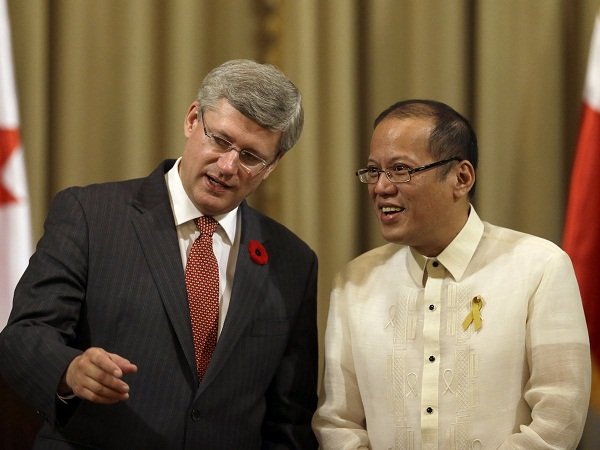
Another Canadian visits P.I.


News item from Philippine Inquirer, dated Nov. 11, 2012 @ www.inquirer.net

"Visiting Canadian Prime Minister Stephen Harper sees the Philippines as “an emerging Asian tiger,” agreeing with the bullish outlook on the country of political and business leaders from many other parts of the world.

To demonstrate Canada’s confidence in the Philippine economy, Harper pledged to increase Canadian investment in the country during his meeting with President Aquino in MalacaƱang on Saturday.

Bilateral trade between Canada and the Philippines amounts to US$1.5 billion.
Mr. Aquino and Harper agreed to cooperate on defense and trade, and committed to people-to-people exchanges between the Philippines and Canada."

Saturday, November 10, 2012

Pitong Gatang.

I'm not talking about seven scoops of rice but the song popularized by Fred Panopio in the early 60's.

The song Pitong Gatang humorously speaks of neighbourhood tales, those spun and told among tambays or buddies while having rounds of beer or hard liquor.

The song is dear to my heart because the neighbourhood where I grew up was nicknamed Pitong Gatang by the grown up men.  It was a small enclave which sat around my Aunt's property, and also called Blue Water because of its proximity to the Pasig River.

Those where the days when there was no drug (shabu) problem, no home invasion, tricycles were unknown, when jeepney plying the Punta-Quiapo route cost 20 centavos and jeepneys were only 8-seaters, and when the first heinous crime - the RCA robbery and axe murder- took place (in 1963).
The crime was later made into a movie by the movie outfit, Dalisay Pictures.


Cousin Gil loves to sing this song in his gigs and at home parties, and happily annoys his female sisters and cousins as he reverts to this song over and over. And my late uncle, Tio Peping, used to sing it during drinking sprees.

Pitong Gatang evokes the simpleness of Filipino life back then, its simple woes and camaraderie among magkakapitbahay (neighbours).

PITONG GATANG
by Fred Panopio

Dito sa Pitong Gatang, sa tabi ng Umbuyan
May mga kasaysayan akong nalalaman
Ito ay hindi tsismis, napag-uusapan lang
Yo de le hi ho, walang labis , walang kulang

May isang munting tindahan sa bukana ng Umbuyan
At sa kanto ng kalye Pitong Gatang
Dito ay nag-uumpukan ang ilang pilyong istambay
Na walang hanapbuhay kundi ganyan

Ito ay hindi tsismis, napag-uusapan lang
Yo de le hi ho, walang labis , walang kulang

Ngunit bakit mayroong tao na katulad kong usyoso
At sa buhay ng kapwa'y usisero
Kung pikon ang iyong ugali at hindi pasensiyoso
Malamang oras-oras basag-ulo

Ito ay hindi tsismis, napag-uusapan lang
Yo de le hi ho, walang labis , walang kulang

(2x)
Yodelehihoo...

Imposible ang maglihim, kung ikaw ay mayroong secret
Sa Pitong Gatang lahat naririnig
At kung ibig mong mabuhay nang tahimik na tahimik
Mag-patay-patayan ka bawat saglit

Ito ay hindi tsismis, napag-uusapan lang
Yo de le hi ho, walang labis , walang kulang


Itong aking inaawit, ang tamaa'y huwag magalit
Ito naman ay bunga lang n'yaring isip
Ang Pitong Gatang kailanman ay di ko maiwawaglit
Tagarito ang aking iniibig

Yodelehihoo...
Yodelehi, yodelehi, oh ho yodelehihi
 Oh ho yodelehihi

Watch Fred Panopio video here.


Monday, October 8, 2012

Not a joke.

Pinoys are the kings and queens of drama.  Madaling mag-emote. (They easily show their feelings).

And when is the best time we, Pinoys, do the emoting?

Let's eliminate the feelings while watching soap operas, and go down to the basics.


When it comes to singing, Pinoys would grab the microphone at karaoke parties, and sing to their lungs' delight.  Bigay todo at full expression, ika nga.  (Full of gusto and feelings).

When it comes to expressing their love, Pinoys would emote top of the line.  Whoever started the harana, (moonlight serenade) anyway?  If yesterday, our grandfathers strummed their guitars to our grandmathers' hearts, today's Pinoy Casanova or Bella would exchange playlists with the object of their desire.

The palengkera-style (below the belt) of quarelling with the loved one, with the neighbour, with the in laws or rotten friends and pasaway na mga tao , is another venue for Pinoy emoting. Colorful oral and body languages are utilized in such scenarios.  May sabunutan, may finger pointing, may murahan, may umbagan.  

With the increasing popularity of social networking and digital communication (wireless, cell phones, etc), Pinoys have been a solid bloc in venting their anger, appreciation, angst, adoration, acrimony and adulation. Be it in politics, showbiz, rumor mongering, and other issues, Pinoys would not forget to add the trademark Pinoy humour or joke - another form of Pinoy emoting.  Magaling magpatawa at madali ring mapikon. 
 ################################################
Sample below of Pinoy humour.  

ERAP JOKES
(Para sa mga Pinoys)
Classmate 1: What is 5 plus 4?

Erap: Eh di 9!

Classmate 2: What is 4 plus 5?

Erap: Gagaguhin mo pa ako eh binaligtad mo lang... eh di 6!
#################################################

And when Pinoys get married, the emoting can burst at the seams. Parents of both bride and groom would both cry out of joy or gloom, and the wedded couples would even resort to gimmicks to celebrate their unions, such as elaborate themes, and out-of-church practises.


But one area where Pinoys are unbeatable is in time of sickness and death. We express our sorrow, pain and loss by visiting the sick, lending support to his/her family, attending the wake and funeral. Even in Mang Dolphy's wake, one could see the "emoting" even of celebrities and ordinary people.
In the average Pinoy household, relatives come together or even have reunions when a family member dies. In some wakes, family members settle their scores with one another, at times becoming destructive, while others make the wake a staging area to upstage friends and family. May naghahalukay ng lumang isyu sa familia, may nagmamayabang. There are even people who'd scream, "sasama na ako sa'yo sa hukay."  But deep in the heart, Pinoys are really cry babies, mababaw ang luha.


The most disheartening kind of emoting is when family members forget their manners, duties, responsibilities and simple ethics. Couples leave one another, children disrespect and disown their parents, and members forget the good deeds and only remember the bad ones.
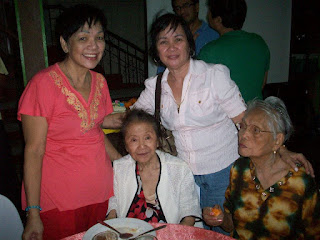
In Memoriam - RITA DESIDERIO- seated in white blazer

                                                                  Of Bustos, Bulacan
                                                                  May 1928 - Oct. 7, 2012
                                                   MAY SHE REST IN PERPETUAL PEACE.

They say that Pinoys are prayerful. And this is where emoting is best.  Pinoys sing during the mass and service, and observe many practises and rituals.  In the Philippine Catholic tradition, there is the pabasa ng pasyon, the Santa Cruzan, the countless novenas, devotion or the panata, among many other practises.

Sunday, August 12, 2012

Up-shore and Impersonal

People like me who live in catch basin towns suffer the brunt of typhoons.  The past "habagat" which dumped more rains than the 2009 killer-typhoon Ondoy flooded most of Metro Manila, and the provinces of Rizal, Bulacan, Bataan and Pampanga.

Listening to the vision of Architect Palafox who glossed over the flood-control master plans of countries like Singapore, Malaysia, and the Netherlands makes one wonder why the Philippines, a perennial disaster prone nation, has not yet implemented similar designs and infrastructures.

The recent pronouncements by President Aquino and DPWH of major flood control undertakings with some being completed in three years and others going into year 2035, provide a glimmer of hope. With the administration's success in keeping PAGASA at its toes in projecting weather disturbances and advising people of forthcoming calamities and its early and massive evacuation efforts, coupled with the quick and coordinated response of delivering food and supplies, the public somehow senses sincerity in Aquino's flood control plans.

Moving to higher grounds temporarily before the recent flood wrecked havoc in our neighbourhood was the best thing we did in this "habagat" phenomenon.  It was up shore and impersonal, yes, but we kept safe and dry. Thanks to relatives and friends.


Friday, August 3, 2012

Our Philippine churches are a gem.

Church of Sta. Teresa de Avila
Yes, it's great to see the Shrine of the Fatima, the Sistine Chapel, the old churches of Spain and Europe, but if you can't, don't lose heart. Our own Philippine churches are a gem themselves.
Santiago de Compostela
Our Lady of Lourdes Shrine in France

St. Francis of Assissi Shrine in Sariaya, Quezon
We went on a healing pilgrimage last Saturday, organized by GLAD, God's Love and Delight.  To Sariaya in Quezon to see the Shrine of St. Francis of Assissi, then to Lucban to the Kamay ni Hesus Shrine, and finally to Pila, Laguna for its Shrine of San Antonio de Padua.

Except for the Kamay ni Hesus Shrine, both the St. Francis and St. Anthony Padua Shrines were built during the Spanish rule.

St. Francis of Assissi (right image) was originally built in 1599, then transferred and rebuilt in 1703, and after an earthquake in 1743, rebuilt in 1748 in its present location in Sariaya.
Kamay ni Hesus Shrine in Lucban, Quezon sits atop a hill reachable by 300 stone steps

The Shrine of Saint Anthony was erected by the Franciscans from 1599 - 1617 originally in Pagalangan and in the late 18th century, due to perennial flooding, the old church along with the town center, was transferred stone by stone to its current site in Sta. Clara.
Shrine of St. Antonio de Padua in Pila, Laguna.
Interior of St. Anthony church

There are about 600, 000 churches and 20 million chapels all over the Philippines while there are only 80 provinces, 143 cities and 1,491 municipalities in the country.  This means that there are multiple churches within cities and municipalities, and even within housing projects or subdivisions.

The more popular and widely known churches and cathedrals in the Philippines are the Manila Cathedral, the San Agustin Church, Sanctuario de san Antonio, Malate Church, Barasaoin Church in Malolos, the Baguio Cathedral, Antipolo Chruch's Nuestra Senora de Buenviaje, Quiapo Church of the Black Nazarene, Church of Obando or the San Pascual de Baylon Church,  Our Lady of Manaog Church, the Vigan Church, Church of St. Joseph in Las Pinas,  and the Basilica Minore de San Martin de Tours in Taal, Batangas, among many others.

I've been to some of these great churches myself. but have yet to see more.

Antipolo Church inscription.
Nuestra Senor de la Paz y Buen Viaje of Antipolo (Our Lady of Peace and Good Voyage)


Basilica de San Martin de Tours in Taal, Batangas is considered the largest church in the Philippines and in Asia


Monday, July 23, 2012

Of Family Reunions.

Butch, a nephew from the U.S. recently posted a picture tucked in another U.S-based nephew's (Rog) refrigerator, and this triggered a lively exchange within family, and then Singapore-based nephew Jei blurted out the R word.

The mention of the word "reunion" brought back memories of childhood, of happy times, of yesteryear.

Reunions generally refer to gatherings of family members or classmates from elementary, high school or college years.

In Canada and the U.S., there is a yearly "homecoming" in high schools and universities.  Whole towns or cities where schools are located busily involve themselves in these events.  Why?  Homecomings generate economic activities and of course, income for local businesses.

Hotels and inns are booked, rental cars and restaurants are patronized, and other incidentals get business, too.  Parades and balls are held, and there's a general feeling of "one-ness" again amongst the townsfolk.

This U.S. and Canadian phenom happen because many Canadians and Americans usually move away from their places of birth and childhood and settle into far away states or provinces where they find work, and start their new lives.

This "homecoming" or "grand reunion" feeling has started to take shape among Pinoys (Filipinos). While before, reunions only happen within the school setting, usually commemorating important milestones (silver, golden, or diamond jubilee), nowadays "grand reunions" take place more often because families have been torn apart by migration and overseas working arrangements.

Since the mid-seventies, many Filipinos have worked overseas.  I remember an Uncle who went to Riyadh in the late seventies, and of course my own sister who took post graduate medical training and then work in Maryland in the mid-sixties.

Ask any Pinoy and seldom will you find any who doesn't have a relative working or permanently settled abroad.

Among OFWs, family reunions, although in smaller scale, occur each time the OFW returns for a visit.  Or when someone in the family gets married, or sadly, dies.

With the recent demise of Mang Dolphy, the whole nation saw the "grand reunion" of the Quizon clan on television. One son proclaimed, " we suddenly became complete, but our Daddy was no longer there to see it."

Love of one's family and clan, and also camaraderie among school pals or co-workers, should always be celebrated; it's a way to remind ourselves of our life journey.

A 1997 wacky film about a high school reunion.
During family reunions, there'd be laughter and sometimes, old wounds are opened. In our extended family, a grand reunion where all those living overseas gather at the same time in one place with the locals has not yet happened. We look forward to one. 

Friday, July 6, 2012

Grapes. Sour.

I love globule grapes; big, seedless and sweet.  If grapes are small, I tend to chew and spit, like "nganga," or betel nut.

When we were small, we used to watch our Dada Ana (grandmother Ana) and her "nganga" brigade do the rituals of ikmo chewing.  They peeled and cracked the betel nut, cut these into small pieces, put in the apog or lime (white sticky gel),  pounded the mixture, lay it on the ikmo leaves, wrapped and chewed it.

My grandmother grew ikmo and transported it to Bulacan as a business so while she and her crew piled the ikmo leaves neatly and loaded them into big native baskets called kaings, they'd be having a "nganga" session.
This is what a nganga looks like. The green leaf is the ikmo, and inside it is the mixture of betel nut and apog (lime).

Any woman the generation of my grandmother and mother worth their salt chewed nganga in our hometown of Papaya (now General Tinio) in Nueva Ecija.  My mother only chewed nganga once when she needed to spit on the open wound of my baby brother; barrio folks believed in the healing feature of ikmo and apog (betel and lime).

I'm not a big grape lover.  But when I hanker for it, I'd get a bowl of grapes, peel them and eat like I'm feasting on potato chips. The peel itself is nutritious but I don't eat it.

One of the byproducts of grapes is the red wine, then there's the dried grape or raisins, both of which I love. When I didn't have diabetes yet, I used to have raisins as snacks.  Now I eat raisins sparingly.

I also drink red wine occasionally now.
My assignment at the kitchen is occasional now so is my red wine habit.

The other day I uncorked a bottle of red wine and now it sits unfinished in the refrigerator.  I have to wait again for my palate to long for its taste, and of course, to have the pep to prepare for the right food to go with it.

In the kitchen I've always been outmaneuvered, so I don't get to cook my kind of food.

Last time we ate out, we went to Mann Hahn so it was Chinese food.  The other time it was lunch at Sbarro's so red wine was out of  the picture. As I'm the only avid red wine drinker in the house, it's a waste to open a bottle.

So one mid-afternoon Sunday when I hankered for alcohol, I poured a Gilbey's, some Sprite, several twists of lemon,  and cracked some ice and enjoyed with it an Oishi cheese-flavored Chips and some peanuts.  That was the Sunday before the big storm this week.

I'm not sour graping, but the Philippine weather doesn't jibe with red wine for me.  The tropics is better enjoyed with beer. Beach and beer. That's cool.
My preferred brand of Beer for now. I can't find Molson in Manila.

Monday, June 18, 2012

What's your memory of Luneta?

The monument of the Philippine National Hero, Dr. Jose P. Rizal, who will celebrate his 151st birth anniversary tomorrow- June 19, stands proudly at the park named after him - the Rizal Park.  It's better known as Luneta Park.


During the execution of Rizal on December 30, 1989, the park was called Bagumbayan or Nuevo Barrio (New Town or the Tagalog word, Bagumbayan). This is also the site where the three martyr-priests, Gomez, Burgos, Zamora were shot.

Luneta or Rizal Park is certainly rich with history.  It is where the Independence Day from the American rule was proclaimed on July 4, 1946, and it is also the favourite site where Philippine presidents take their oath and where they're proclaimed president of the Republic.

I'm sure everyone has her/his own memories of Luneta Park.  

As a youth in the late 50's and early 60's, my father used to bring us to Luneta on Sundays.  He'd pack us eight kids into his huge green Pontiac and drive through Paco and onto the wide lanes of Dewey Boulevard, now Roxas Blvd.  

We'd run and inhale the sweet scent of Manila Bay (this to combat a nagging cough as my parents used to tell us). "Malinis ang simoy ng hangin, magaling sa ubo."

Of course the water of Manila Bay was clean and pure those days.  You can actually taste its saltiness as you clear your throat and try to inhale way deep down your stomach.  We'd even ride the bote or ferry for a short cruise of Manila Bay.

As we grew older, our trips to Luneta became scarce.  Sometimes some of us kids sneaked out on our parents and asked our cousin to drive us to Luneta to watch the skaters trut their wares, or we went there during school class trips.

As we matured even further in the late 70's and early 80's, Luneta became a place not to be.  The Park, although refurbished largely by the late Doroy Valencia and the ex-First Lady Imelda Marcos, deteriorated in status and became synonymous with cheap trysts and forbidden activities which took place in the many dimmed mazes of the Japanese Garden, along the shore and inside the cars parked near the Cultural Centre and the Folk Arts Theatre.

Even Rico J. Puno immortalized Luneta in his Tagalog version of The Way We Where, "namamasyal pa sa Luneta kahit walang pera."

Like its benefactors, the Marcoses, Luneta symbolized both the excesses and filth of the Martial Law years, with its mammoth structures and rehabilitation done in haste to court foreighn tourists and to hide the stink of the dictatorship, squatters in and along the Boulevard, among many others.

After the Marcos' downfall, new politics arrived and in the succeeding years, Luneta seemed to be forgotten with its crumbling pavements and vagrancy problems, until the late 90's and the early 2000's when Atienza and the Erap administration brought revival to the Boulevard by the Bay.
Luneta's Fountain


So Luneta continued to survive.  As Luneta was originally envisioned by the American colonizers,  (Philstar 2000 article), it was a dream.

"The dream had started at the turn of the century as the Americans sought to shape the city in the image of a great colonial capital. Daniel Burnham stood at the old Luneta (somewhere around the present Rizal monument) and saw that the greatest asset of the area was its proximity to the waterside and the "priceless" view of the magnificent bay and the daily magic of its fiery sunset.

But the port works were already in progress and were blocking the view so he immediately suggested the extension of the waterfront a thousand feet into the water. This reclamation would also allow for a hotel and other leisure facilities on either side of the extension framing a clear and unimpeded view of the bay. These were built within 10 years of the plan and have been part of Manila's historic landscape for the past 85 years. Three generations of Filipinos have enjoyed the priceless amenity of this open space. Future generations may not be so lucky."

Today, Luneta is on the roll.  With the Baywalk and an extended acreage into the Bay, the Park provides added tourist income, but less view, less clean air and diminished space for the strollers. 
Now, visitors to Luneta may take an evening Manila Bay boat cruise which features food and entertainment. 


No more wind in your face, as in our youthful years.

Wednesday, May 30, 2012

Guilty as charged.

The now former Chief Justice of the Supreme Court issued a statement from his hospital bed that he, Renato Corona, accepts the guilty verdict handed down by the Philippine senator-judges.

Renato Corona was found guilty of not declaring truthfully his assets in his Statement of Assets, Liabilities and Net Worth.

Majority of the senator-judges who gave Corona the guilty verdict were not lawyers.  Majority of the Filipino people who followed the impeachment proceedings were non lawyers, too.  As Senator Lito Lapid, when casting his verdict said to this effect, "ako po ay high shool graduate lang, di marunong mag ingles, hindi ko naiintindihan ang mga legal talk, pero ako bilang representante ng mga mahihirap at di nag aral ay boboto base sa aking konsyensya."  He found Corona guilty as charged.

Before Ferdinand E. Marcos was ousted from his post through a People Power,  the Filipino people never imagined for a moment, that Marcos would be overthrown. It was simply unthinkable.  Why? Because he controlled every nut and bolt of the government and military machinery; anyone who defied him, landed in jail or was never seen again.

It was unthinkable, too, that Joseph "Erap" Estrada would have been thrown off his Malacanang seat; it was not the impeachment trial that did him in, but another EDSA uprising: EDSA DOS.

Renato Corona, not being an executive figure was relatively unknown by the Filipino masa. He came into radar only when he prominently issued a TRO to allow ex-President Gloria Arroyo to travel out of the country.

That's why at the start of his impeachment trial, very few Filipinos knew the extent or importance of the proceeding against him. But as the trial progressed, the Filipinos started to learn more about the case and about the man Renato Corona.

When he testified in his trial, when he lambasted personalities in his testimony in a three-hour long diatribe, when he stormed out of the impeachment court, and when he finally came back and admitted that he had 2.4 million dollars and 80 million pesos stashed in banks and undeclared in his SALN, suddenly, almost 75% of the Filipino people casted a guilty verdict on the ex-Chief Justice.

Although Corona's popularity and approval rating had been continually slipping and was at its lowest negative 14, the guilty verdict became cemented in the people's minds and in most senators' minds in the last week of the impeachment trial.

If this same scenario happened in the U.S.A or Canada, I would venture to say that five months would have been too much.  The Clinton impeachment trial took just two months to be completed.

In Canada, impeachment takes another form, in that the Prime Minister can be voted out of office, by a vote of non confidence by the Parliament where a new election can be called.

With the conviction of a Chief Justice who is charged with protecting a corrupt ex-President Gloria Macapagal Arroyo, the Filipino people is elated at the prospect of change - that the present administration would push through with its promise of eradicating corruption.

Miriam Defensor Santiago said that the Philippines has always been voted as a most corrupt nation. No doubt about that; corruption has been a problem made worse by the Marcos dictatorship.

Since more and more Filipinos are working overseas and have been exposed to the democratic workings and economic successes of developed nations, these same Filipinos are demanding more and more accountability, transparency and progressive policies and actions from their government.

I remember a very rich American woman, Leona Helmsley, who was convicted of tax evasion by a New York federal court. She served 19 months in prison and more under house arrest. 

Her household help heard her say:  "We don't pay taxes. Only the little people pay taxes...", a saying that became notorious and was identified with her for the rest of her life.

Leona Helmsley mug shot.